What Is Compound Interest? How It Works, Formula, Examples & Benefits (2025 Guide)
Introduction
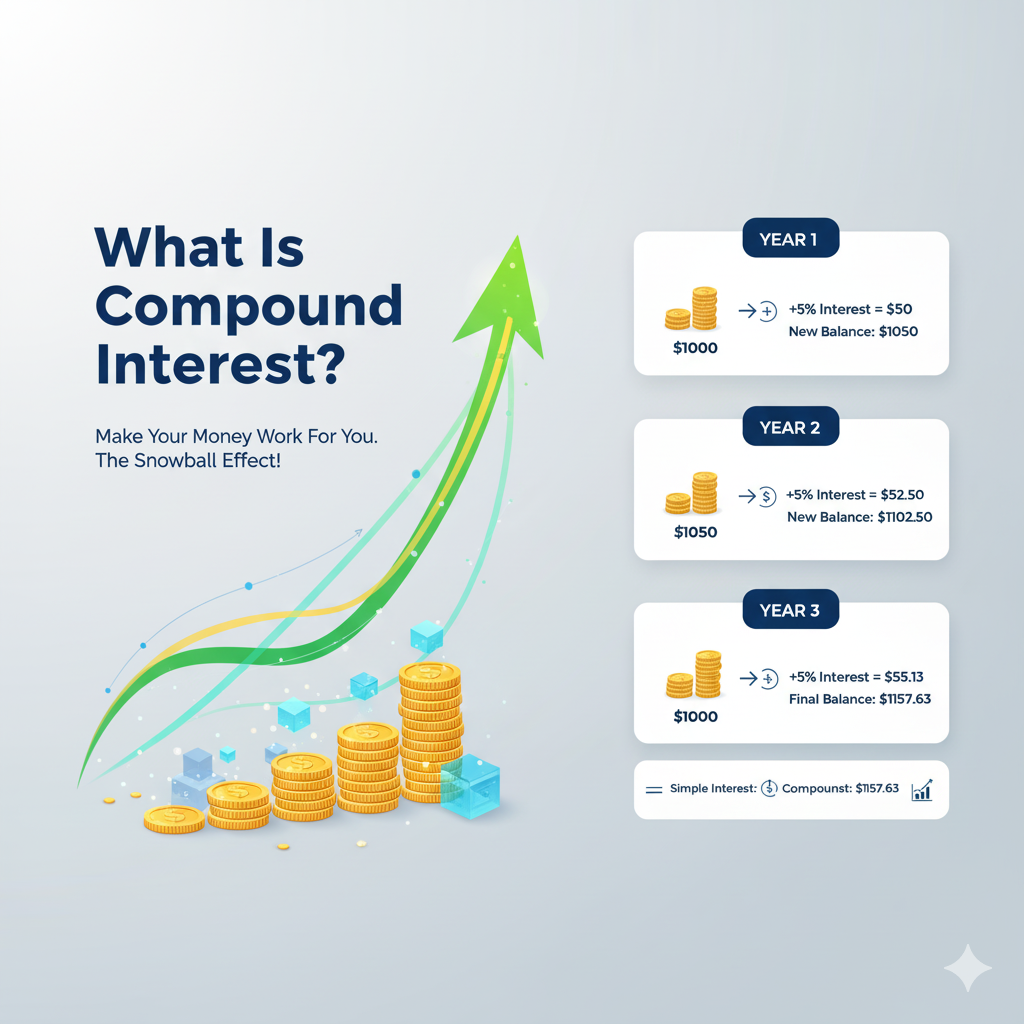
Compound interest is one of the most powerful financial concepts in the world. It helps your money grow faster by earning interest on both your initial deposit and the interest you have already earned. Whether you are saving for retirement, building a long-term investment plan, or simply trying to grow your money, compound interest can dramatically increase your wealth over time. In this guide, we explain what compound interest is, how it works, why it matters, how to calculate it, and how you can use it to build long-term financial security.
What Is Compound Interest?
Compound interest means earning “interest on interest.” Unlike simple interest, which only grows based on your original amount, compound interest grows based on the total balance—including previously earned interest. This creates exponential growth, meaning your money increases faster over time.
In simple words:
Compound Interest = Interest on your money + interest on the interest already earned.
How Does Compound Interest Work?
Compound interest works by reinvesting the interest you earn back into your balance. Each compounding period (daily, monthly, or yearly), your balance increases slightly. Over time, these small increases grow into a significant amount.
Example:
If you invest $1,000 at 10% annual interest:
- Simple interest after 1 year: $1,100
- Compound interest after 1 year: also $1,100
But after 10 years: - Simple interest total: $2,000
- Compound interest total: $2,593
You earn an extra $593 just because of compounding!
Why Is Compound Interest Important?
1. It accelerates your wealth
Compound interest grows your money faster than simple interest. The longer you leave it, the bigger it gets.
2. Helps long-term goals
If you’re saving for education, retirement, or a big purchase, compound interest helps you reach your goals quickly.
3. Encourages early saving
The earlier you start, the more time your money has to grow exponentially.
4. Works automatically
You don’t need extra effort. Once money is invested, growth happens on its own.
Compound Interest Formula
The standard formula for calculating compound interest is:
A = P (1 + r/n) ^ nt
Where:
- A = Final amount
- P = Principal amount
- r = Annual interest rate
- n = Compounding periods per year
- t = Number of years
Example Calculation
Let’s say you invest $5,000 at 8% interest, compounded monthly for 5 years.
- P = 5000
- r = 0.08
- n = 12
- t = 5
A = 5000 (1 + 0.08/12)^(12×5)
A ≈ $7,469
Your money grows by $2,469 without any extra deposits!
Factors That Affect Compound Interest
1. Interest Rate
Higher interest = faster growth.
2. Time
More time = more compounding = larger returns.
3. Compounding Frequency
From slowest to fastest:
Yearly → Quarterly → Monthly → Daily
4. Additional Contributions
Adding money regularly boosts total growth.
Simple Interest vs Compound Interest
| Feature | Simple Interest | Compound Interest |
|---|---|---|
| Calculation | Based only on principal | Principal + interest |
| Growth | Linear | Exponential |
| Best for | Short-term loans | Long-term savings & investments |
| Returns | Lower | Higher |
Compound interest always wins in the long-term wealth-building game.
Real-Life Examples of Compound Interest
1. Savings Accounts
Your bank gives you interest, and it compounds monthly or yearly.
2. Retirement Accounts (401k, IRA)
Money grows tax-advantaged and compounds for decades.
3. Investment Funds
Stocks and mutual funds offer high long-term compounding through reinvested gains.
4. Fixed Deposits / Term Certificates
These also use compounding to increase value.
How to Make Compound Interest Work for You
1. Start as early as possible
Even a few years’ head start makes a huge difference.
2. Increase your contributions
Adding even small amounts boosts compounding.
3. Choose investments with higher long-term returns
Stocks, index funds, and ETFs typically give better compounding over time.
4. Avoid withdrawing early
Interrupting compounding slows your growth.
5. Let money grow long-term
The most excellent compounding benefits occur over many years.
How Much Can Compound Interest Grow Your Money? (Example Table)
| Years | Initial: $1,000 @ 10% |
|---|---|
| 1 | $1,100 |
| 5 | $1,610 |
| 10 | $2,593 |
| 20 | $6,727 |
| 30 | $17,449 |
This magical growth happens without any extra work.
Benefits of Compound Interest
- Builds passive income
- Promotes financial discipline
- Reduces financial stress
- Helps you achieve big goals
- Protects against inflation
Common Mistakes to Avoid
- Starting too late
- Withdrawing your earnings early
- Choosing low-interest accounts
- Not investing long-term
- Skipping monthly deposits
Final Thoughts
Compound interest is the foundation of thoughtful financial planning. It allows your money to grow exponentially over time, helping you build wealth without constant effort. Whether you invest in savings accounts, mutual funds, or retirement plans, the key is to start early, stay consistent, and let time do the work. Understanding and using compound interest can put you on the path to long-term financial success.



Post Comment